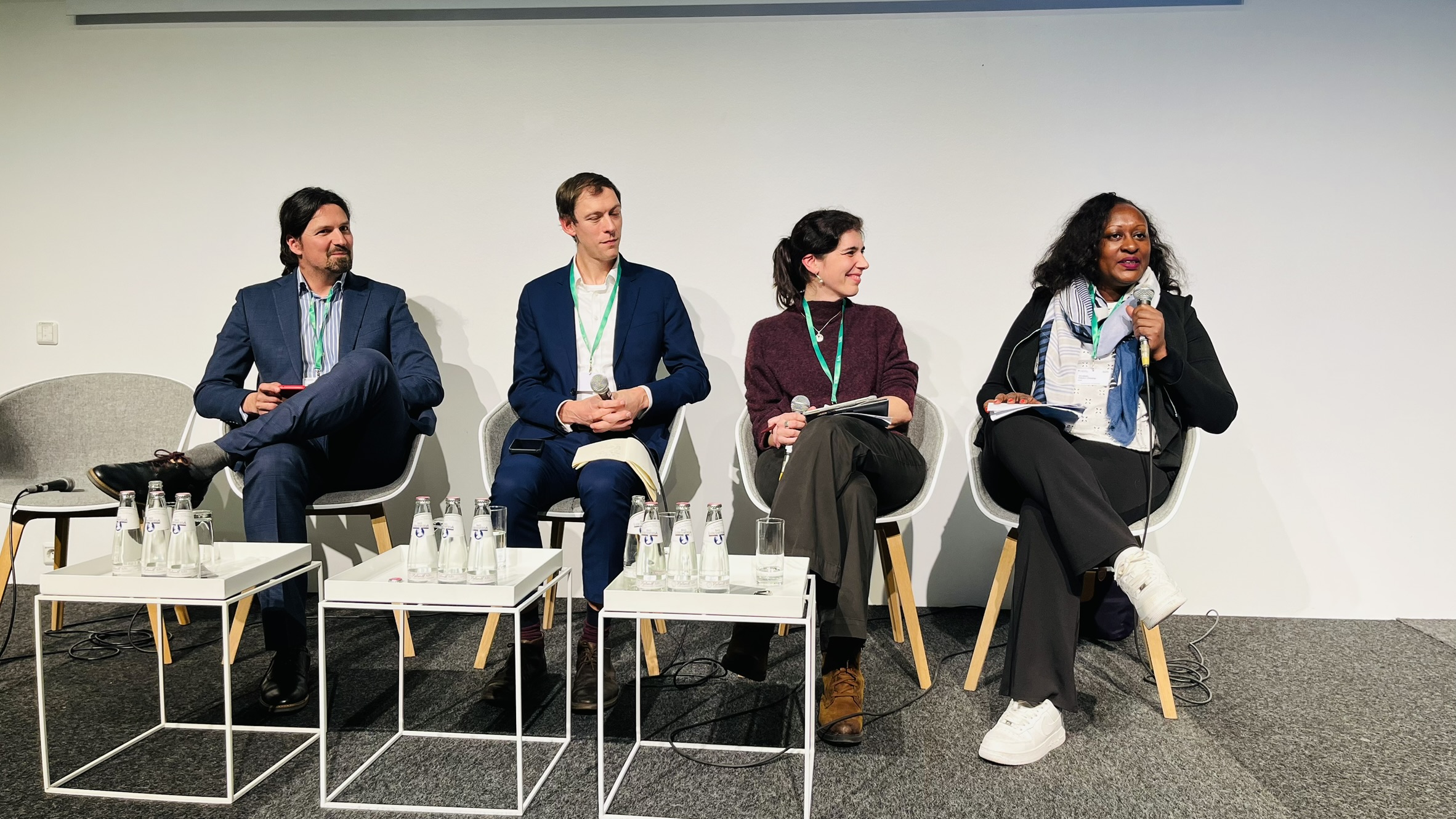
Berlin, Germany, January 2026 – The panel “Shared Solutions for Africa’s Water-Energy-Food Systems”, co-hosted by the Power for Food Partnership and the Agri-Energy Coalition, delivered powerful insights on how integrated solutions at the water-energy-food nexus can help transform food systems across sub-Saharan Africa at the Global Forum for Food and Agriculture (GFFA) in Berlin on 15 January.
Decentralised renewable energy (DRE) solutions, in particular solar-powered irrigation systems, combined with sustainable farming practices have the potential to overcome these challenges and sustainably increase the production of healthy and diverse foods. Achieving this requires cross-sector collaboration throughout the areas of agriculture, water, energy and nutrition.
Grants and subsidies should serve as bridges to sustainable markets, not long-term crutches, while finance must better match company scale and expand local currency solutions.
A few key takeaways from our expert panel and speakers:
Bas Hetterscheid (Wageningen University & Research) set the scene with a clear message: progress requires collaboration. Moving toward collaborative and facilitative approaches requires aligning KPIs, priorities and incentives across sectors.
Elizabeth Kaijuka Okwenje (Government of Uganda) shared how Uganda is tackling the nexus through a programmatic national development approach, encouraging ministries to work together around agro-industrialisation and productive use of energy, linking planning, budgets and implementation.
Petra Schmitter (International Water Management Institute (IWMI)) highlighted the role of development agencies as knowledge brokers: translating evidence across sectors, addressing water risks, improving data sharing and adapting financing tools so that innovations don’t create new problems.
Carlos Sordo (GOGLA) brought the market lens, highlighting where off-grid solar for agriculture is taking off, such as in irrigation, and where more work is needed, e.g. post-harvest, agro-processing, and discussing the need for blended finance, affordability, market linkages, policy coherence and sustainable business models.
Christopher Emmott (Acumen) made the finance case: public and concessional finance must de-risk early-stage nexus investments, absorb market-building costs and help companies reach scale, without creating dependency on subsidies and grants.
Barbara Richard (Deutsche Gesellschaft für Internationale Zusammenarbeit (GIZ) GmbH) closed with a strong call for integration over silos, stressing that real progress in the water-energy-food nexus depends on policy coherence, joint planning and evidence-based decision-making across sectors.
This engaging conversation was moderated by Lawrence Haddad CMG (Global Alliance for Improved Nutrition (GAIN), helping panellists connect policy, finance, research and market realities into a coherent narrative.
The nexus isn’t about abandoning sector goals, it’s about achieving them better, together, while reducing risk and making smarter use of resources. Lasting impact requires African-led solutions for African challenges, with international partners supporting, rather than defining, the path forward.